Shabbos: The Wick That Still Holds
Understanding Shabbos through the lens of Parashas Vayigash
Chanukah is over and now we miss the flames that were our most tangible connection to the Ohr HaGanuz. They appear to be gone with their oil used up, yet the light lives on. It moved into our neshamas. Now we need to make sure we do not extinguish that light for the soul of Chanukah stays with us all year round.
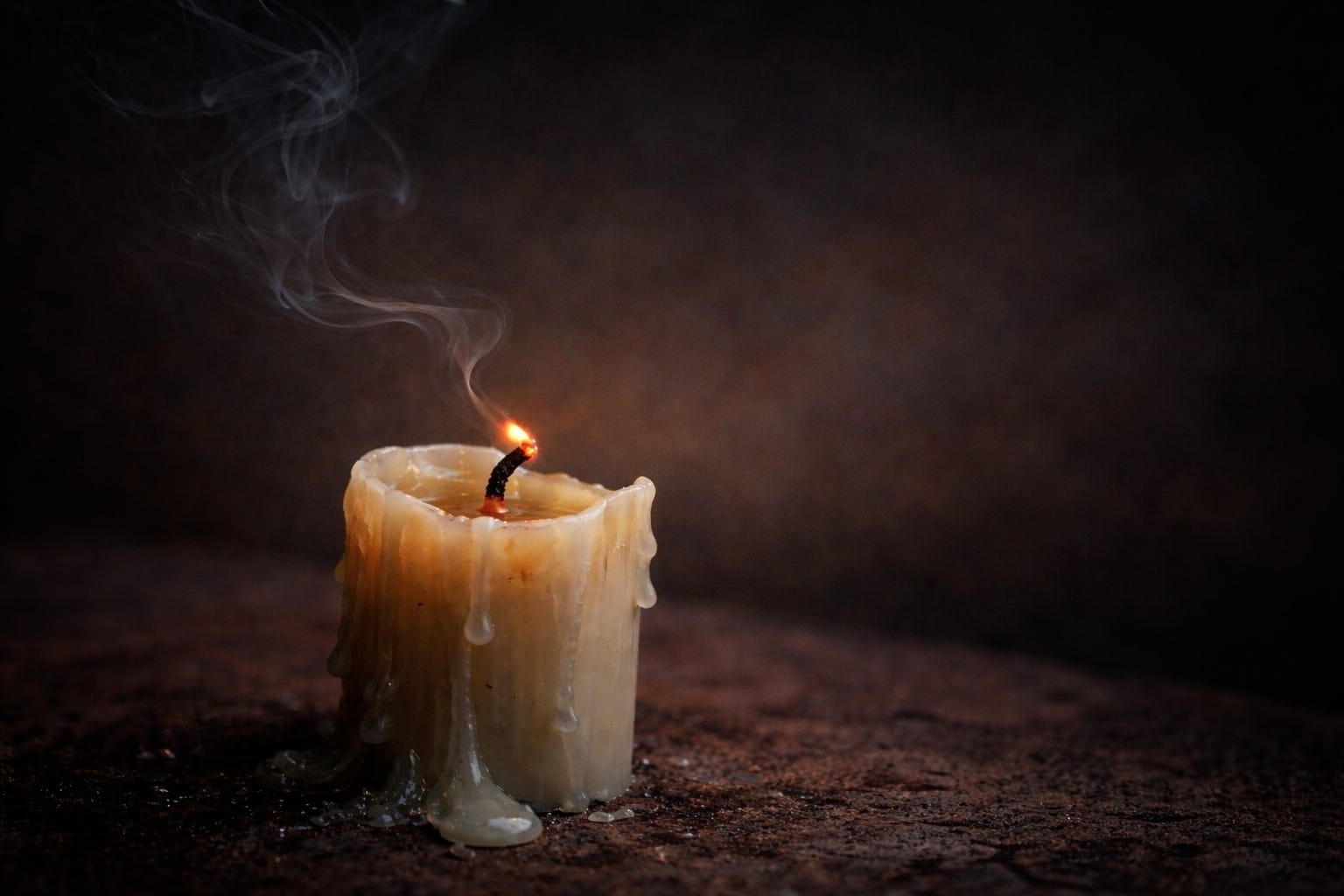
Recently, I noticed a tea light starting to flicker out. The wick somehow got dislodged from the little metal piece on the bottom. I tried to straighten it and in the process the flame got extinguished. I tried to relight it by bringing another flame close so it could catch and was unsuccessful. It hit me that some lights do not respond to pressure. They need a different angle, maybe a trimmed wick, fresh air, or patience.
People tend to be like that too. When someone seems far from the Source of light, our instinct is to push, nudge, or flood them with our glow and hope it catches. However the way to keep a candle burning is gentler. The key to success is to clear the draft, warm the wax, and wait for the flame to rise. The goal is not to overpower their light with ours. Rather, it is to make room for theirs.
The Beis Yaakov adds a dimension that makes this feel less like a nice metaphor and more like a foundation for understanding the human psyche and soul. The world was given to human beings, which means we live inside bechirah, free choice. We also live inside the forgetfulness that comes with it, to the point that we can lose sight of the most basic truth that the strength we experience as “ours” is constantly being handed to us by Hashem.
Torah interacts with this fog like a lighthouse, filled with mitzvos and gedarim (limitations) that keep pulling a person back toward the recognition that nothing we do is detached from Him.
The Beis Yaakov then explains something even deeper: light itself reaches a person through more than one channel. He points to the classic distinction between amirah and dibbur, discussed throughout the meforshim. Dibbur is closer to the speaker. Adam is called חי מדבר, because dibbur expresses the act of forming speech itself, the חיתוך האותיות, the human work of shaping letters and sound1. Amirah speaks more to the content that the words carry, and it lands with more distance from the speaker2. Another way to feel this is relational: dibbur creates a meeting between the speaker and the person being spoken to, while amirah can remain a statement said to someone, without that same face-to-face binding.
Practically, amirah can sound like a general question offered to a crowd, where each listener chooses how deeply to respond. Dibbur sounds like a direct address, where a person feels spoken to, summoned, and compelled to answer. That distinction helps explain why Chazal described creation as עשרה מאמרות, while the Torah was given as עשרת הדברות. The world reveals its Author through layers and multiplicity, while Torah confronts us with His will in clarity and demands a response. Reading the world resembles reading a book and sensing the author through the pages. Learning Torah becomes meeting the Author Himself.3
The Izhbitzer then translates all of this into the language of light. Amirah and dibbur operate like a dimmer switch. Dibbur can arrive with force, intense illumination that reshapes a heart. Amirah can arrive as a tzimtzum, a softened beam. The Ramchal describes something similar on a spiritually cosmic level. Before tzimtzum, the light was endless, so it was not “visible” as a distinct thing. After tzimtzum, it becomes recognizable, because it now has a shape a human being can relate to.4 That is why measured light can be held, and overwhelming light can remain out of reach.
The truth stays the truth, yet its delivery shifts because a human being grows through choice and earning. Sometimes the most loving thing Heaven does is dim the glare so the flame can live.
That is why amirah settles differently from soul to soul. In some people, Torah settles inwardly, and it becomes part of who they are, even when their awareness feels foggy. In others, Torah stays on the outside, like a story they can repeat accurately, while their life keeps moving on separate tracks.
The same principle applies after a fall. Once one sees that light can arrive in measured form, one can also see why it survives even when a person falls.
The Beis Yaakov explains that even when someone falls into darkness, something remains. Even when the flame looks spent, it still holds. He calls it a kusta de’chiyusa, a stubborn point of life that stays present when everything else feels shaky.
The question shifts from how hard we can push a flame back to life to whether we can give it air. Sometimes the way Hashem grows that spark begins with fear. A person senses the loss of what they still carry, and that fear itself becomes the opening. Then Hashem saves them with something they never knew to ask for.
The idea of a spark that survives is reminiscent of the luz bone:
In Chassidus, memory is about the past and also about what will be. The luz bone works the same way. It remembers who we were before we were broken, and it remembers who we are capable of becoming. It stores the promise along with the past.
The luz bone is the invincible presence that holds on to who we are, even when everything else has collapsed. It connects heaven and earth, the darkest night with the brightest day, the constriction of our past with the infinite unraveling of our future. The luz is more than a remnant. It is the home and conduit of kedushah. The luz bone represents the part of you that never died to begin with.
Every person, no matter how shattered, carries within them a nekudah, a point that cannot be reduced, broken, or contaminated. This point stands independent of spiritual performance or emotional health. It is the etzem, the luz, the irreducible essence of who we are.
You can lose your way, faith, and practically everything, but you can never lose your luz.
The luz remembers our wholeness. It carries a quiet knowledge of who we were before we were broken, and who we are meant to become. In that sense, the luz is about the ongoing resurrection within life, a memory that builds. The luz bone also carries us into something closer: techiyas ha’panim, the resurrection of the self. The reawakening of hope. The return of who we really are.5
As we’ve learned, the time to nourish this spark, this kusta de’chiyusa, is on Motzaei Shabbos, at Melaveh Malkah. Chazal say we do not make a brachah on fire except on Motzaei Shabbos, because that is the beginning of its creation, the first time the world learned how to carry light into the dark week.6 In that moment, when the holiness of Shabbos receded and the world felt dark again, Hashem revealed that there is still room for this ember to glow again. We can carry Shabbos into the week.
The Beis Yaakov connects this directly to Motzaei Shabbos. Shabbos is a day of standing before Hashem, not a day of self-assessment. On Motzaei Shabbos, when we return to bechirah and hishtadlus, we make a blessing on the candle, because light is what lets a person see what he has received and carry it into the week. The Sfas Emes7 explains that the moment Shabbos leaves, you suddenly feel the absence of Shabbos. That feeling becomes the reason you protect what you received on Shabbos.
In other words, there is a kind of light that arrives too directly to be integrated, and there is a kind of light that arrives in measured form, so it can be held. The first kind of light may be truer, but the second kind is what makes room for a person to use their own bechirah and actually internalize it. That is why the candle belongs to Motzaei Shabbos. It is the light that translates holiness into the week.
In Parshas Vayigash is where we see that a flame is protected not by intimidation or pressure, but by the right conditions. Only after Yehuda descends fully into darkness, after he confronts his guilt and responsibility and learns to speak from a place where clarity stays out of reach, only then can Yosef finally break his silence. That sequence is precise. Yehuda’s entire path is salvation built through concealment. In the moment, it looked wrong
The Beis Yaakov says this is the inner world of the baal teshuvah, where the turning point comes through a cry from the depths, the kind of plea that reaches Hashem when nothing else makes sense.
Yehuda thought he was standing before a foreign king who had decided to crush them. His arguments were not airtight. His leverage was not real. What he did have was a heart that refused to stop pleading. He kept speaking until he awakened the ratzon Hashem. Then revelation came and with it a terrifying kind of clarity: nothing changed between the moment before and the moment after. The only thing that changed is that the mask fell away. The “enemy” became a brother. The danger that felt absolute became something that had been standing in front of them all along, only hidden.
That is what the Beis Yaakov points out about the emotional moment of “אני יוסף אחיכם.” They were hoping for one narrow rescue and to get Binyamin back. Instead Hashem did “awesome things we did not expect,” and salvation arrived in a form they never imagined: Yosef himself.
That is why these two worlds have to touch here. The two brothers were finally at a place where they could recognize each other and see that the light they were seeking is the same, just two ways to attain it.
Where Yehuda represents dibbur, Yosef represents a different kind of holiness. He is the man of amirah, the man who creates conditions.
The haftarah takes that meeting and turns it into a national image. Yechezkel describes two sticks, one for Yehuda and one for Yosef, brought together until they become one in his hand. The reason why it needs to be two sticks and not one stick with both their names on it is to teach us that to be unified does not require erasing our unique identity. Unity does not require erasing differences. Yehuda remains Yehuda, Yosef remains Yosef, and the joining happens because they share one direction.
This idea is so important that it is on display in the Kodesh Kedoshim. Chazal describe two silver rods hidden inside the Aron, placed there for their meaning rather than their function. They were not useful in the practical sense, yet they signaled something essential: the Jewish people endure because both paths matter. Even when we cannot see how the pieces fit, Heaven holds them together as one.
This is why when Yaakov sent Yehuda ahead to request that the family settle in Goshen, Yosef understood that his father was asking for more than the choicest land. He was asking for a setting in which the flame of Bnei Yisrael could rise again.
The Beis Yaakov describes Yosef as the one who knows how to contract. He unites giver and receiver by making room, so the other person can feel, honestly, that they earned their portion through their own effort. That is what dignity looks like. Yosef could have dragged his brothers into his Egyptian success story. He could have translated them into his language and system. Instead he creates the space they need to breathe - where their flickering ohr can catch again.
Yosef does more than save his family from famine. He designs an environment where they can survive without dissolving. In Goshen their collective flame can rise independently, without being suffocated by the Egyptians around them. It is geographically distant from Egyptian society, and it is socially distant too, because shepherds are viewed as an abomination, so nobody rushes to invite them into the mainstream. Yosef even coaches them to say, plainly, “We are shepherds.” He builds a boundary on purpose.
Yosef understood Egyptian culture well enough to use it for holiness. If the brothers presented themselves as respectable Egyptians-in-training, Pharaoh would have placed them inside the system. If they presented themselves as shepherds, the system would keep its distance. Yosef chose the option that kept them distinct.
Rav Moshe Dovid Vali frames this as more than logistics. Yosef did not choose Goshen because it was simply available. He chose it because separation was the only way the family could survive Egypt without becoming Egypt. Goshen became a protective distance, not a hiding place. It was a boundary that let them eat, work, and raise their families while staying themselves.
That same idea is Havdalah in another form. Separation is not rejection. Separation is what makes a relationship possible without losing oneself inside it. Yosef builds Goshen the way we build a week after Shabbos, with boundaries that protect identity and keep the light from being swallowed by noise. When there is no boundary, there is no holiness, because nothing remains distinct enough to be carried.
The Beis Yaakov strengthens this point by contrasting Egypt with Eretz Yisrael. Egypt is the place where water rises on its own, where a person can live as if nothing is coming from above, and where it becomes easy to mistake stability for self-sufficiency. Goshen, inside Egypt, becomes Yosef’s way of creating a controlled environment where the family can eat, work, and settle without being absorbed into that illusion. It protects them from Egyptian culture, and it protects them from the inner mindset that says, “I do not need help from above.”
Instead of forcing his brothers into his world of Egyptian success, he makes room for their identity to breathe. He feeds them, advocates for them with Pharaoh, gives them a place to stand, and then lets them be who they are. Their light does not need to become Yosef’s light in order to keep burning.
Yosef thus learns how to move from control to care, and Goshen is the moment where he stops managing them and starts building the environment for them to live. This is how one protects a flickering flame. Not by leaning in harder, but by giving it the kind of space where the hidden spark finds air again and rises on its own.
Yeshaya when explaining the role of Mashiach at the end of days, says וּפִשְׁתָּה כֵהָה לֹא יְכַבֶּנָּה ‘a dim wick … he shall not snuff out’.8 A dim wick still counts as a wick. It still holds fire. It still deserves patience. Rav Moshe Dovid Vali9 explains this as part of Mashiach’s task in the world: to bring truth into the open with steadiness and courage, even when the moment feels resistant. The message is simple and demanding. The wick may look weak, yet truth has its own persistence, and the light keeps moving forward.
This also explains why Yosef is so central here. Yosef represents the work of boundaries, with careful structure, which is the work of the weekday and the work of exile. Yehuda represents the inner truth that the entire story, including the parts that feel tangled, stays held inside ratzon Hashem. Goshen is where those two meet in practice: Yosef builds the structure, and Yehuda fills it with meaning, so it becomes a place of growth, not only a place of endurance.10
The pasuk says Yaakov sent Yehuda ahead, “לְהוֹרוֹת לְפָנָיו גֹּשְׁנָה,” to show the way to Goshen. The Bat Ayin adds that Goshen is not only a geographic solution, but a spiritual framework. Goshen is the same gematria as שמחה and as אור סוף. His point is that the family learned to bring אור into the סוף, meaning they learned to draw redemptive light into the lowest layers of a dark environment.
There is also a striking gematria on the word גשנה itself: גשנה, משיח, and נחש are all 358. Even the phrase “ה׳ מלך ה׳ מלך ה׳ ימלך” equals 358, which ties this moment directly to malchus.
Goshen holds the same root-number as both the nachash and Mashiach, because the same spiritual energy can turn in opposite directions. It can twist into separation and exile or it can be refined into unity and return. Yosef’s greatness was not only that he saved them from famine, but that he built a protected space in which Yehuda and Yosef could reunite, and in which the process of tikkun could begin inside one family before it ever becomes the story of the whole world.
The highlight of this week’s parsha is the coexistence of Yehuda as Yehuda and Yosef as Yosef. Through their choices, we learn an idea that we can carry with us from Chanuka and through the year at Havdala. The lesson is to embrace each person’s flame as it is, giving it the space to be. Bnei Yaakov had that space in Goshen and there we grew into Bnei Yisrael until it was time to move forward to Eretz Yisrael.
Maharal, Gur Aryeh, Yisro
Radak; Gur Aryeh
Heard from Rav Dovid Bashevkin
Ramchal, Kalach Pischei Chochmah 25-26
Pesachim 54a
Ki Tisa וינפש
Yeshaya 42:3
Teshuos Olamim, Yeshaya, 42
As we saw in the story of Pilegesh b’Givah, Binyamin represents the part of the family that endures even when protection feels thin. The family holds together through more than one strength. Yehuda supplies the stubborn courage to keep pleading. Binyamin carries the vulnerability of a light that wants to stay alive. Yosef brings the discipline of boundaries and the art of making room. When those forces align, the ohr does not need pressure, so it returns.


